



Failure to properly clean and disinfect medical devices can lead to client harm. It is important to understand the classification of the equipment you use in your practice, what is required to safely and effectively clean, disinfect or sanitize it, and whether or not you should be outsourcing this work to someone else.
Understand the Classification and Manufacturer’s Requirements
All medical devices and equipment approved for use in Canada are required by Health Canada to include manufacturer’s instructions for the appropriate use and reprocessing of the device or equipment. Manufacturer’s instructions must take into consideration the intended use and potential risk of infection arising from the use of the device. You should find this information with the original instruction guide. If you cannot find this information you should be able to get it directly from the manufacturer or find it online.
All medical devices can also be classified using the Spaulding Classification System which divides reusable medical devices into three categories based on their intended use and the potential risk of infection involved in their use. The Spaulding Classification provides guidance on the level of reprocessing required for reusable devices belonging to each category as seen in the figure below (found in our Infection Prevention Guide for Physiotherapists).
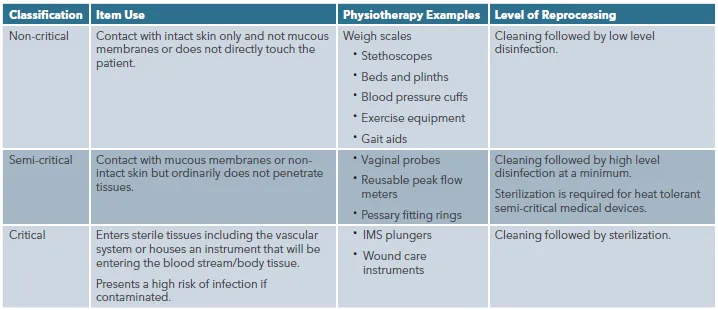
If there is a discrepancy between the Spaulding Classification System and the manufacturer’s instructions you must reprocess the device at the higher level of disinfection or sterilization.
In-house or outsource?
Decisions around whether you can appropriately clean, disinfect, or sterilize medical devices in-house or not are important to consider. Those who use semi-critical and critical devices in their practice must figure out whether they can effectively sterilize those devices in-house or if they have to outsource the work to companies that can do it to the required level.
There are significant risks to your clients if you do not properly process devices to the required specification. If you choose to do this in-house you must have the competence and equipment to do so. It is one thing to be competent to wipe down a treatment plinth or a piece of exercise equipment, but quite another to reprocess semi-critical or critical devices. If you do go down this road, you may want to look at taking a course to get a better sense of what this looks like.
There are companies that you can outsource this to where they will collect your devices, reprocess them, and bring them back. These companies employ staff who have been trained to do this work and should have the equipment to safely and effectively process your devices. If hiring someone to do this work on your behalf, you are advised to confirm the qualifications and arrangements in use by the contractor.
Resources
The College of Physiotherapists of Alberta has the following resources you can access for further information on medical device reprocessing and other topics related to infection prevention and control.
- Infection and Prevention Guide for Alberta Physiotherapists
- VIDEO: IPC Game Show
- IPC Modalities Quiz
- Good Practice: Infection Prevention Control – A Focus on Modalities in Practice and Disinfecting Protocol
- Good Practice: Reusable Medical Device Reprocessing
Action Items
- Review what medical devices you have in your practice site.
- Identify what level of cleaning, disinfecting or sterilization is required for each piece of equipment.
- Ensure policies and procedures you employ at the practice site reflect the level of reprocessing required.
- Get training if you are processing critical and semi-critical devices. If you are unsure you can do this safely and effectively at your practice site, look for options to outsource this work.


